
With so many beautiful stays to choose from in Bali, and such great value to be found, it’s worth taking the time (and spending a little extra) to find a hotel that lets you truly relax and indulge in the tropical heat. While I appreciate having a comfortable home base, I also enjoy sampling a variety of hotels when transfers are easy, the itinerary allows, and my travel partner is also game to bop around.
On my most recent trip to Ubud, we split our time between two incredible properties – Komaneka at Monkey Forest and Bambu Indah. The former offered a serene escape in the heart of town with plenty of desirable amenities. The latter delivered a wellness retreat in the jungle. Both were excellent stays that exceeded expectation.
- Resort Amenities in the Heart of Ubud: Komaneka at Monkey Forest
- A Serene and Sustainable Jungle Oasis: Bambu Indah
Note: This post contains affiliate links. I may earn a small commission if a purchase is made through these links, at no extra cost to you. I only include links to products, properties or services I have direct experience with, have seriously researched, or would personally recommend.
Resort Amenities in the Heart of Ubud: Komaneka at Monkey Forest
One of five Komaneka Resorts in Bali – four of which are located in Ubud – Komaneka at Monkey Forest blends boutique luxury with cultural immersion. Situated just steps from the Sacred Monkey Forest Sanctuary, the property is uniquely connected to a fine art gallery specializing in contemporary Balinese and Indonesian works. Beyond the gallery, the open-air reception and guest villas are tucked away from the main road, creating a tranquil hideaway in the heart of the city.
Passing through the reception area, you’ll find the hotel restaurant on your left and a small Hindu altar on your right. Swaying coconut fronds and dangling of Birds of Paradise flowers adorn your path to the villas.
Prime Location in the City Center
When planning our trip, I was deciding between staying at Komaneka at Monkey Forest and Temuku Villas. Though Temuku’s Pool Villa was at a very competitive price point for similar amenities, Komaneka’s central location ultimately won me over:
- Just a 10-minute walk to central Ubud, the location eliminated the need to rely on hotel shuttles or taxis.
- Even when hotels offer complimentary transport, I prefer the freedom of not having to follow a fixed schedule, especially since most shuttles stop running in the evening.
- In Ubud’s heat and humidity, the ability to explore the city and then pop back to the hotel for a swim, drop off shopping bags, or take a short break (and a blast of air conditioning) was a real plus.
- The resort’s complimentary daily yoga classes and afternoon tea service were incredibly enticing perks.
- Being within walking distance of Jalan (Jalan meaning “road” or “street”) Monkey Forest’s best restaurants, shops, and bars was incredibly convenient.
- Consistently glowing reviews for their hospitality helped seal the decision.
If you don’t mind staying in a more remote area (e.g. you plan to spend most of your time at the resort), Temuku Villas might be a more tempting choice. I’ve even seen room rates offered with a floating breakfast.
The Pool Villa Experience: Space and Serenity
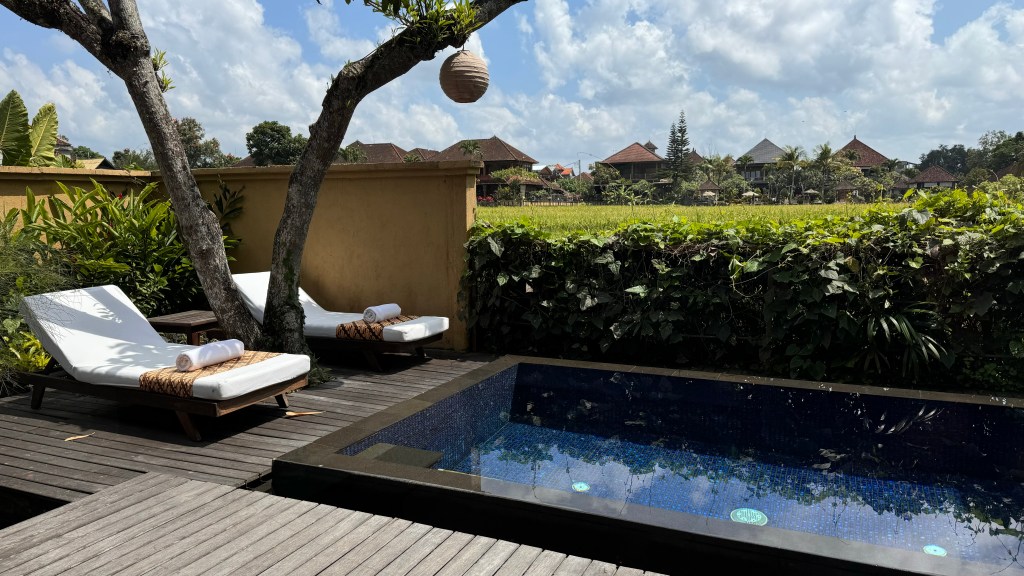
Bali (and Southeast Asia in general) is one of the best places to indulge in luxury for less, and our private Pool Villa was no exception. While Komaneka at Monkey Forest features a tranquil communal infinity pool, it was worth the splurge having our own private plunge pool right outside our bedroom.
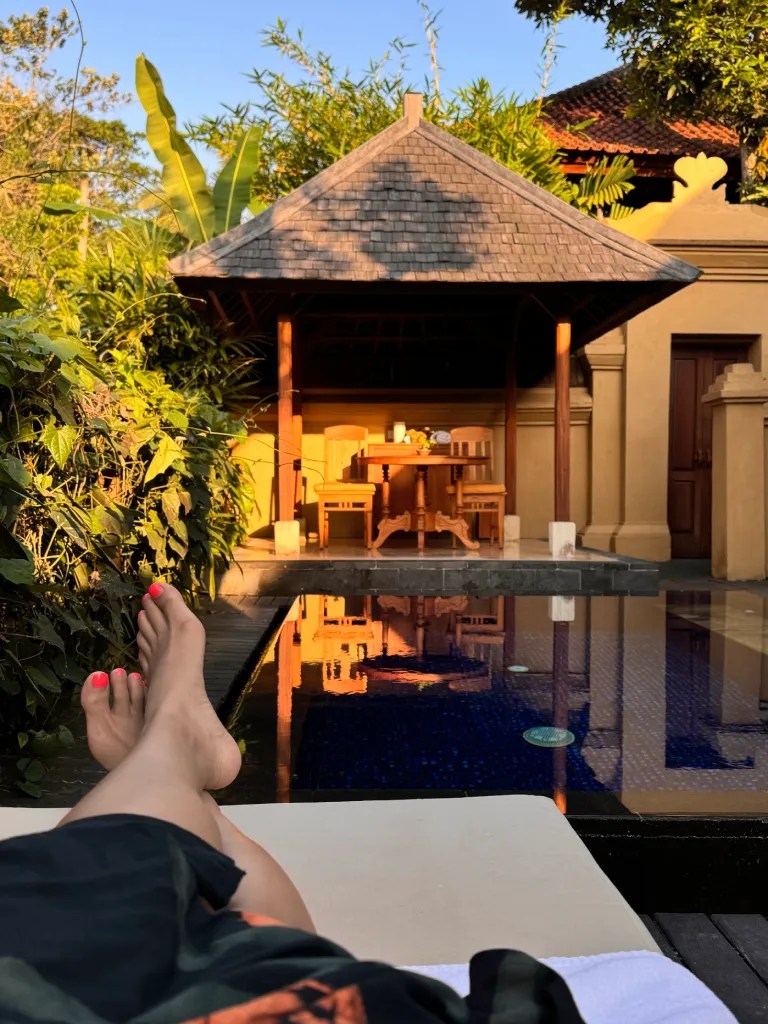
At one end of the pool was a shaded lounge area with a minibar (refrigerator), and a small dining table and chairs. At the other end were two cushioned lounge chairs, perfect for sunbathing or relaxing. Hotel staff came to set up the loungers each morning while we were at breakfast with cushions and fresh linens – we never had to lift a finger.
A low stone wall separated our villa from the rice paddies, offering a peaceful view where we sipped tea and coffee in the mornings, watching tiny finches perched on rice stalks, bobbing up and down.
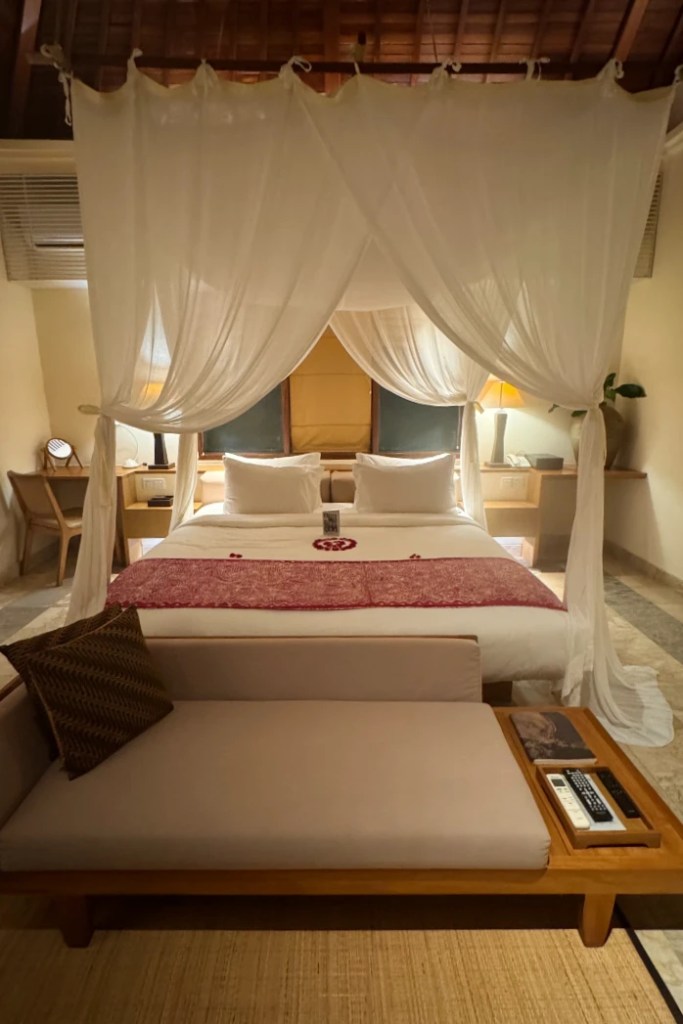
Inside the villa, the king-sized bed was draped with gauzy mosquito nets, and the room was equipped with a wall-mounted flat-screen TV. The spacious bathroom boasted a massive soaking tub, separate rain shower, and dual vanities.
Complimentary in-room snacks included white and dark chocolate bars, canisters of truffled potato sticks, and a small cookie jar filled with Famous Amos-style mini chocolate chip cookies, the latter of which was refilled daily. That cookie jar nearly got us into trouble with the local monkeys.
Daily Yoga Classes in an Art Gallery
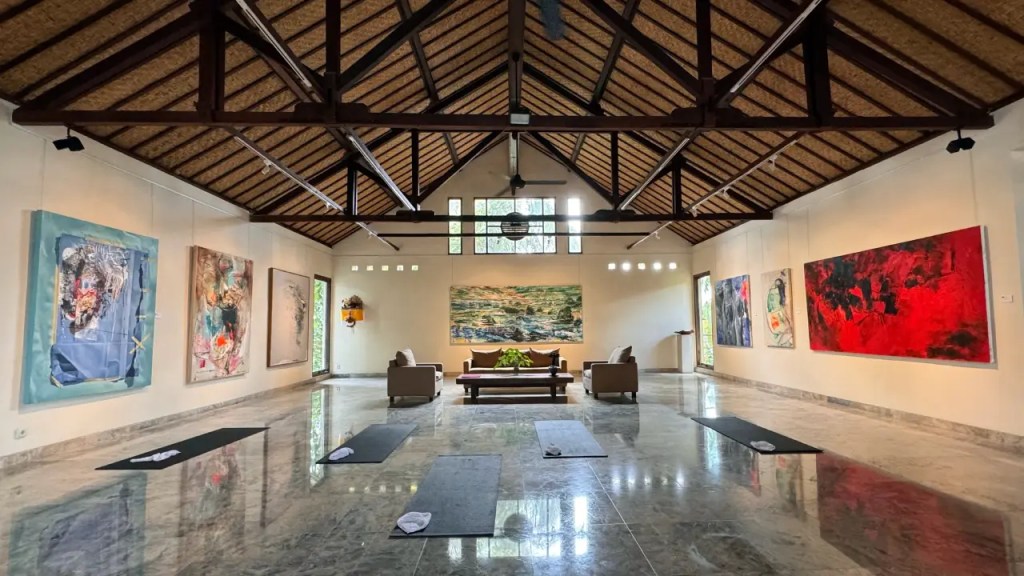
We began two of three mornings with complimentary daily yoga classes at Komaneka, led by local Balinese instructors. Each lasted one hour long and mats were provided. The classes took place in the art gallery before it opened to the public, so we had a quiet, peaceful practice.
Our most memorable instructor was a feisty older woman, dressed in a traditional all-white Indonesian set. She was wildly charming and had a vigorous, slightly intense teaching style. While pushing us to our edges, she reassured us that with dedication, we too would one day become as flexible as she was.
Complimentary Breakfast
What’s better than not having to leave your hotel for food? Mornings at Komaneka at Monkey Forest began with leisurely, made-to-order breakfasts offering both Indonesian specialties and Western classics. We leaned towards traditional dishes like nasi goreng (fried rice) and gado-gado (vegetables with peanut sauce).
The beverage menu was extensive, with freshly brewed coffee, herbal teas, and colorful, frothy fruit smoothies (The vibrant purple of dragonfruit is a feast for the eyes). We typically shared a plate of assorted tropical fruit and a basket of breads and pastries to start. While options like the Belgian waffle were available, I tended to stick with the Indonesian offerings, which felt more flavorful and of the place.
Afternoon Tea: A Delicious Perk
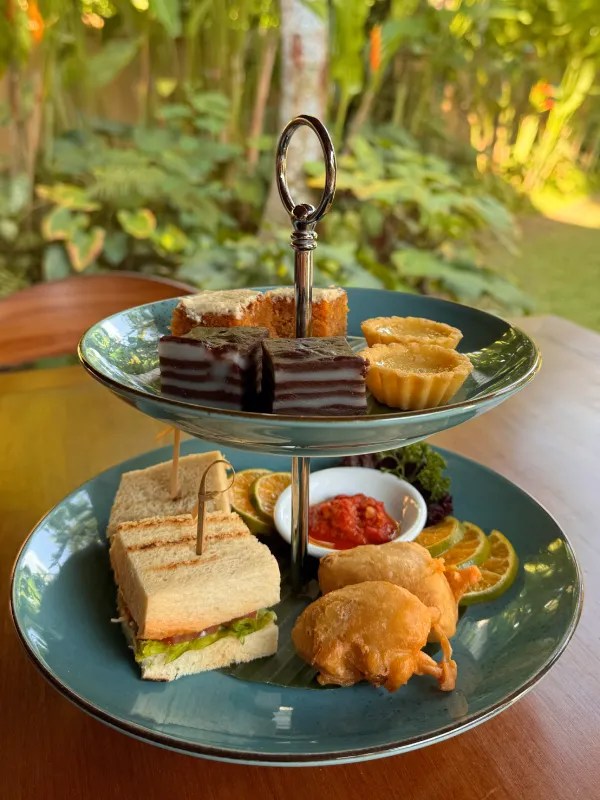
Each afternoon, Komaneka served a complimentary high tea (included in the room rate), and we made sure not to miss it. Premium loose-leaf teas are served in individual teapots (I went with jasmine). A three-tiered tray of gourmet treats (one per two persons) featured a mix of savory Indonesian snacks and delicate desserts, ranging from kue lapis (a moist, layered cake made from rice flour and sago) to mini key lime pies.
When we were out and about and too busy to pause for lunch, these mini meals helped hold us over until dinner.
Beware The Monkeys!
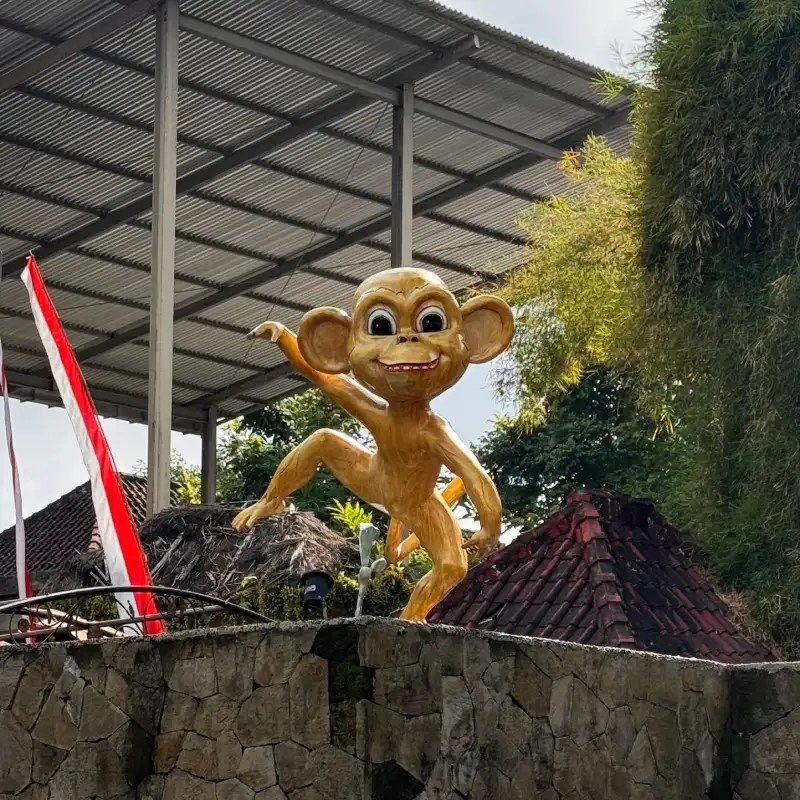
Not surprisingly, there are monkeys at Komaneka at Monkey Forest. (It’s in the name, after all.)
The further south you walk along Jalan Monkey Forest, the more you’ll see them traversing power lines, climbing poles, or casually loitering along the street. At Komaneka, we’d often spot them climbing and leaping from rooftop to rooftop while we sipped our morning coffee at the villa. I never felt threatened by them because they generally kept their distance… that is, until our last day at the resort.
To commemorate our last morning at the hotel, I thought we might enjoy some of the mini cookies with our tea under the gazebo. I brought the jar outside, assuming – wrongly – that the monkeys, who had never approached us before, wouldn’t be a problem.
An alpha monkey locked eyes on the jar, marched right up to our table, and snatched it from us before we could react. With the alpha clutching the jar, the other monkeys took this as their cue to descend upon our villa. I was cornered.
We watched in horrified suspense as the alpha clawed at the lid, attempting to pry it open. The scene playing out in my mind was a grenade going off and cookies flying everywhere – a monkey free-for-all.
Leah kept her cool, sternly commanding the monkey to drop it (She does this all the time with her dog!). After what felt like an eternity (including a terrifying display of teeth – a sign of monkey aggression), it dropped the jar, giving Leah just enough time to snatch it and toss it inside our room, defusing the cookie grenade.
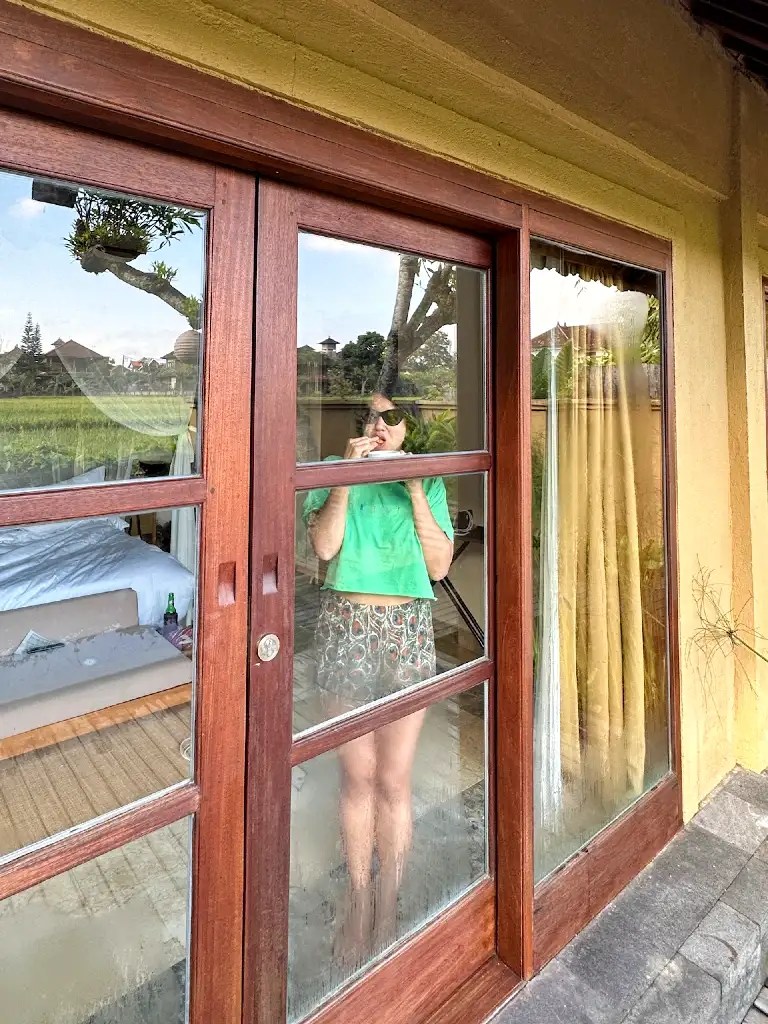
I eventually made it back inside to the safety of our room and called the front desk, who sent someone to chase off our uninvited guests – but not before another monkey managed to break into our minibar fridge and was trying to open a can of Bintang beer by hurling it at the ground.
The experience made for a memorable (if slightly traumatic) story. We agreed that the hotel could have offered more guidance on how to handle monkey encounters (or a slingshot for self-defense). Regardless, we learned a lesson that day. Upon checkout, the hotel did not charge us for the banged-up Bintang. We even all shared a little chuckle about it.
Transferring Hotels and Getting Around in Ubud
Transportation in Bali is generally affordable and easy to arrange. While you can use rideshare apps in Ubud, there’s also no shortage of taxi drivers milling about, and fares are typically quite reasonable by Western standards. That said, it’s always smart to agree on a price before getting into the car. For short distances, get a few quotes to compare; some drivers may quote inflated rates based on what they think tourists will pay.
As a point of reference: we paid around $10 USD for a private van transfer (with luggage) from Komaneka Monkey Forest to Bambu Indah, about a 10 to 15-minute ride. We were able to negotiate a $20 USD airport transfer with the same driver easily.
A Serene and Sustainable Jungle Oasis: Bambu Indah
Bambu Indah was a big reason for returning to Ubud. After Komaneka at Monkey Forest, we planned to transition to a more secluded, nature-immersed retreat where we would just hang out (we’d spent the prior three weeks running through Australia).
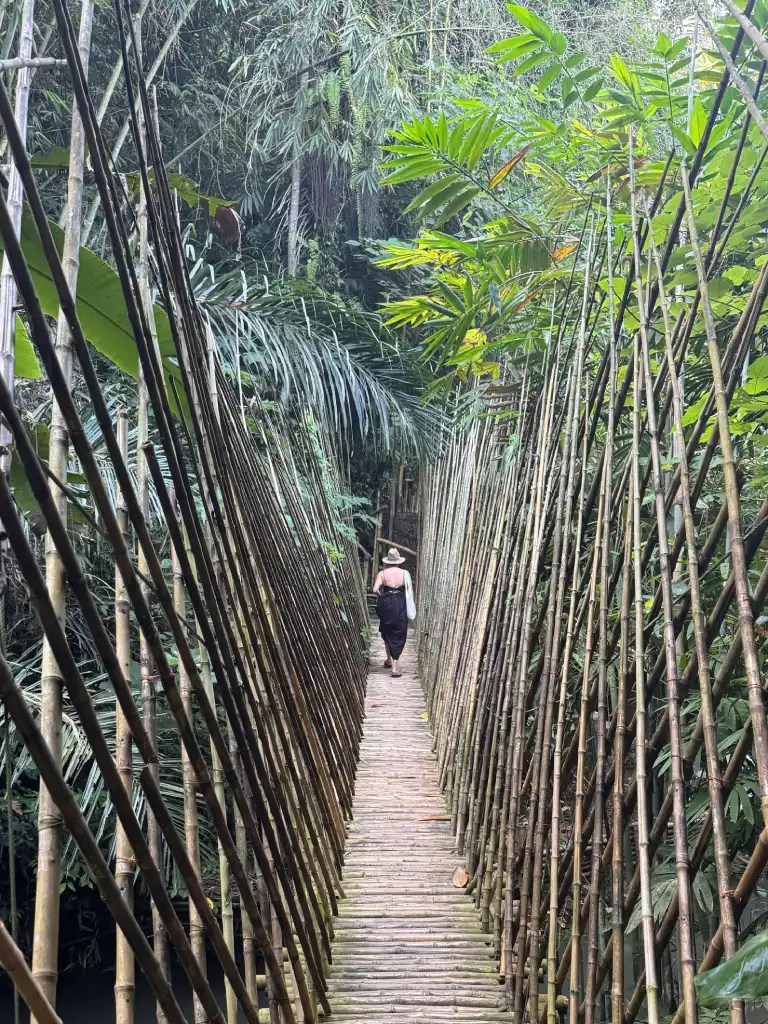
While it was tough to leave Komaneka’s warmth and hospitality, Bambu Indah offered an entirely different experience: a sustainable, eco-luxury resort surrounded by rice paddies, jungle, and natural pools.
It is owned and developed by the John Hardy family, whose jewelry brand originated in and has long been tied to Bali/Indonesia. Bambu Indah reflects a deep commitment to green architecture, which heavily incorporates bamboo – in the guest rooms, shared spaces and bridges that connect the resort grounds.
The Mahogany Tents: Glamping in the Treetops
Bambu Indah offers a variety of unique accommodations, from restored Javanese teak bridal houses to open-air, copper-shingled platform apartments, to bamboo treetop tents. We stayed in Tent #1 (the two tents of this kind have since been re-branded as the Mahogany Tents), designed for “adventurers, lovers, and dreamers.”
The tents are one of the most cost-effective lodging options at Bambu Indah, yet stll among the fanciest tents I’ve ever stayed in (around $250 USD per night at the time of booking).

When deciding whether to book a tent, I wondered if we’d be shorting ourselves the full Bambu Indah experience by not choosing more luxe accommodation. Ultimately, it was completely worth it. Apart from the somewhat loud portable air conditioner, there’s really nothing I would change.

Perched high above the jungle, reaching the tent requires climbing a steep staircase, but the effort is well worth it. To preserve the light footprint of this accommodation, and considering the effort required to get up there, guests are asked to repack essentials into a small bag, while porters store the rest at reception and deliver the essentials to the tent upon check-in.
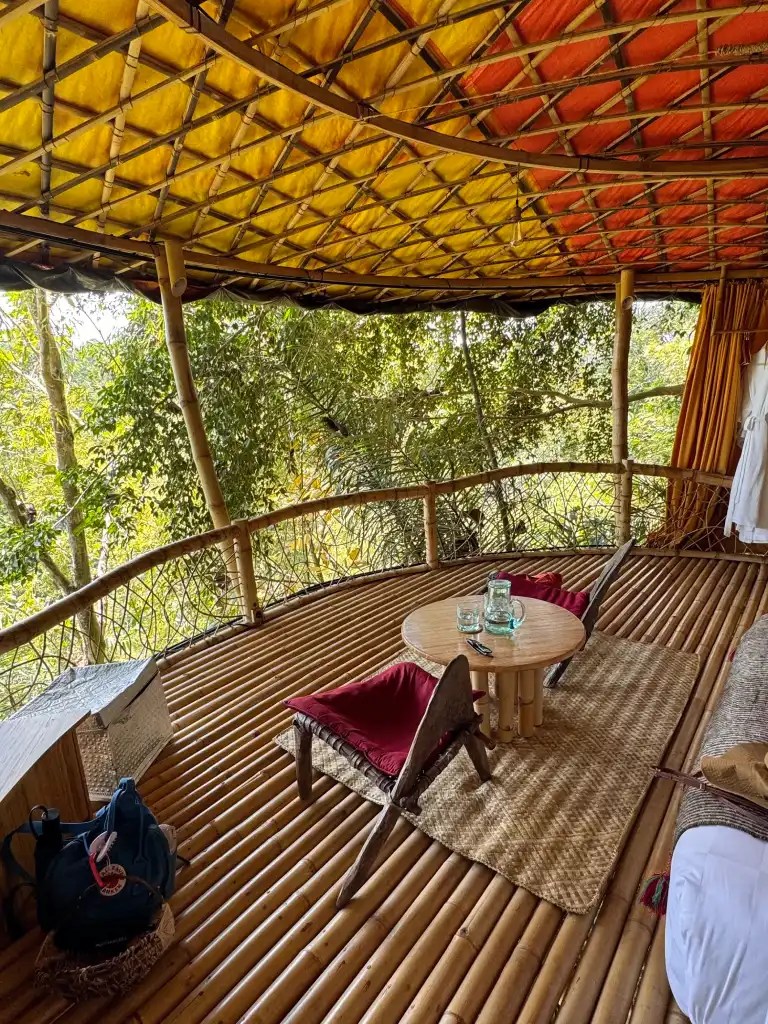
The Mahogany Tent is constructed entirely from bamboo, creaking underfoot as you walk (something to be aware of). Enjoy views of lush greenery from every angle. There are no doors or locks, just a curtain entrance, reinforcing the immersive jungle experience. The room has a small safe for valuables.
There’s a complimentary minibar stocked with coffee, tea, bottled water, flavored kombucha, two cans of Kura Kura beer (one lager, one IPA), and assorted snacks like dried papaya strips. Kept cool in the fridge was a sticky yet delicious house-made granola bar wrapped in a banana leaf.

The cozy queen bed is draped with a large, collapsible tent (on a bamboo frame, naturally), which helps keep cool air in and mosquitoes (and other unwanted critters) out at night. At the bedside you’ll find a portable air conditioner. While it was a bit loud, it was much appreciated. There’s even a slingshot to ward off unwanted visitors. Fortunately, we never had to use it. (It would have been more useful at our previous Ubud stay).
The private bathroom is just steps from the tent, featuring a fully flushing toilet with a treetop view and outdoor shower.
Dining at Bambu Indah: Riverside Warung , Tembaga, and the Floating River Bale
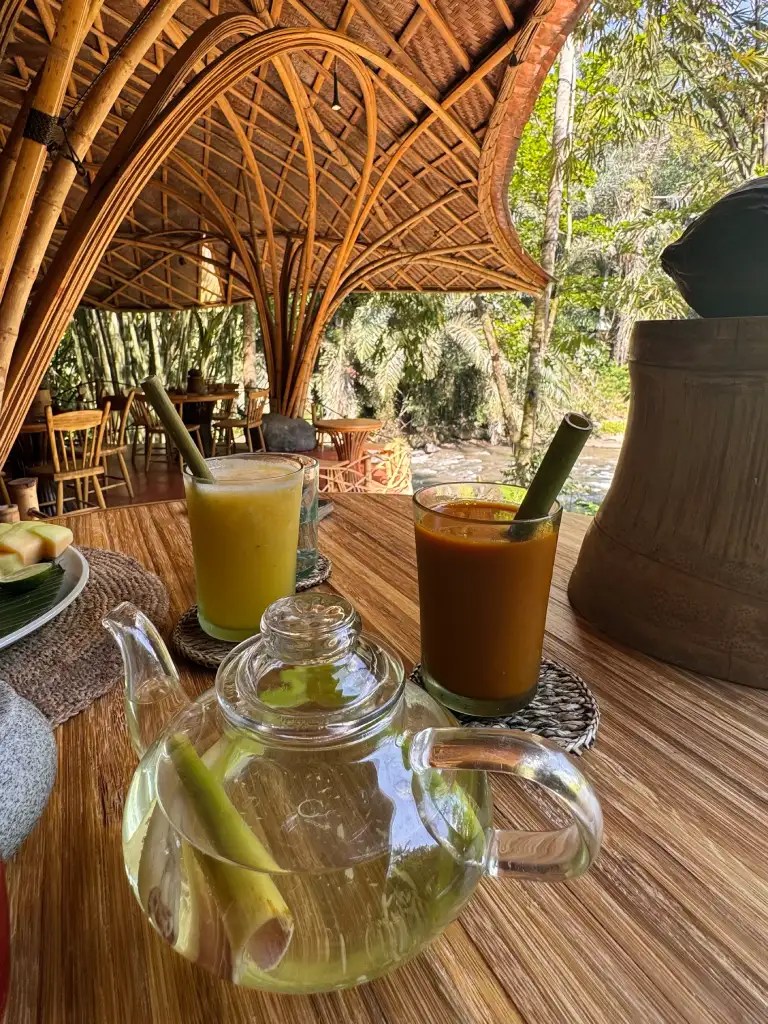
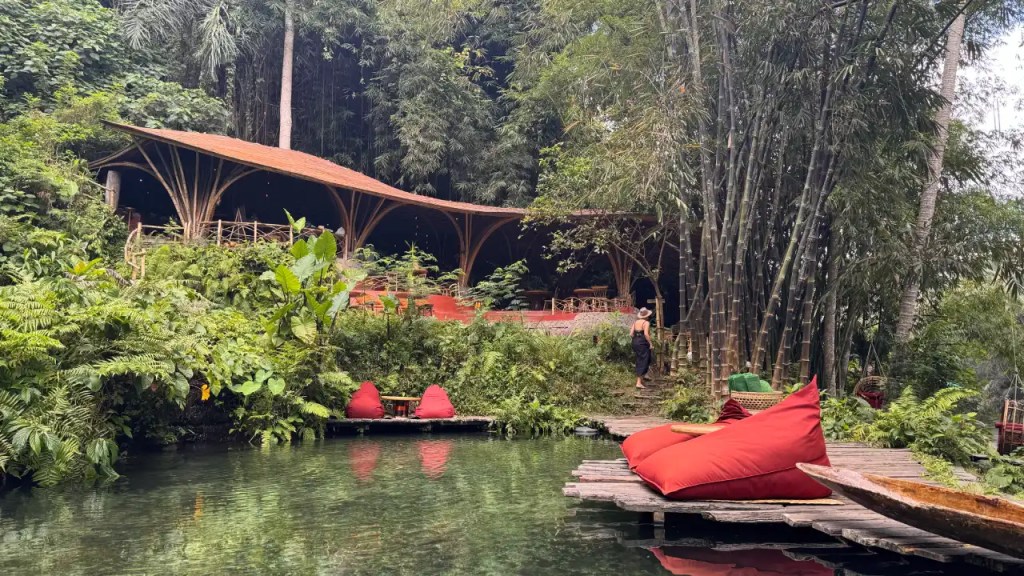
Breakfast at Bambu Indah is served in the Riverside Warung, an open-air restaurant overlooking the natural pools and the Ayung River. While there are standard chairs and tables, our preferred seating was on the bench with cushions, in line with the boho luxe atmosphere.
Every meal we had at the Riverside Warung was excellent – flavorful yet clean. Leah often started with Balinese coffee, while I sipped on Lemongrass tea. (Be warned that the turmeric juice is particularly potent – definitely more of a wellness shot than a sipping beverage!) The fried eggs (hatched on the property) were served with sides of sautéed spinach, grilled tomato, organic mushrooms, and a crispy hash brown.
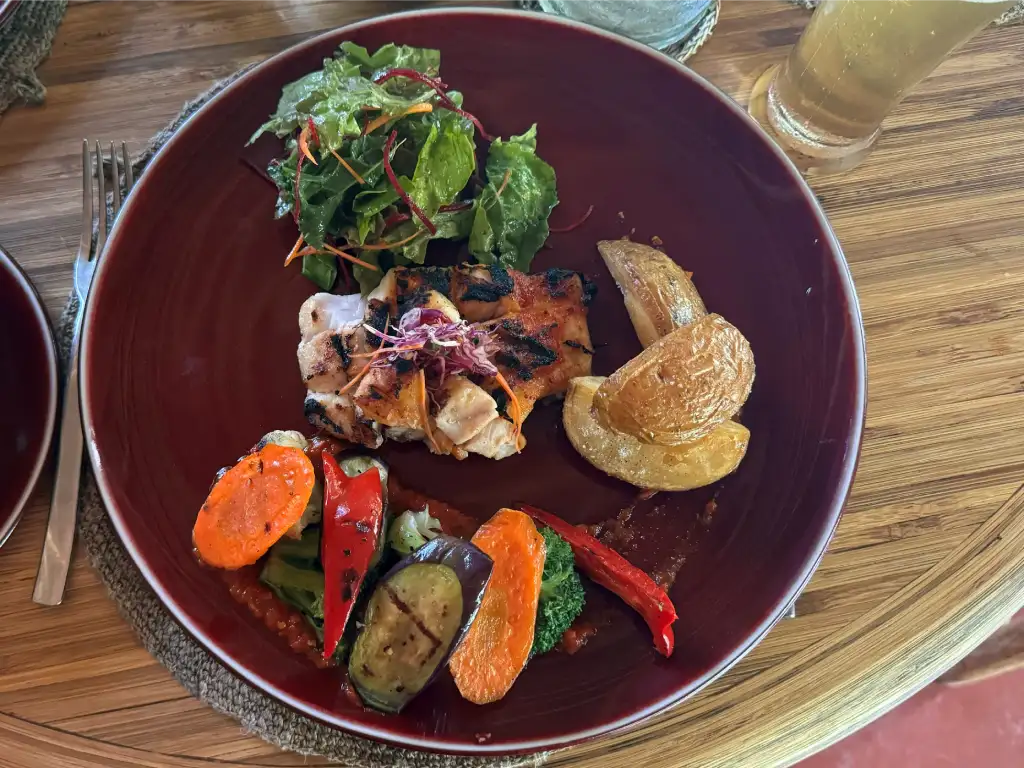
We had lunch at the Riverside Warung upon arrival at the resort and both ordered the Fish Chilli Lime Sauce, which came with a side salad, grilled vegetables and roasted potatoes.
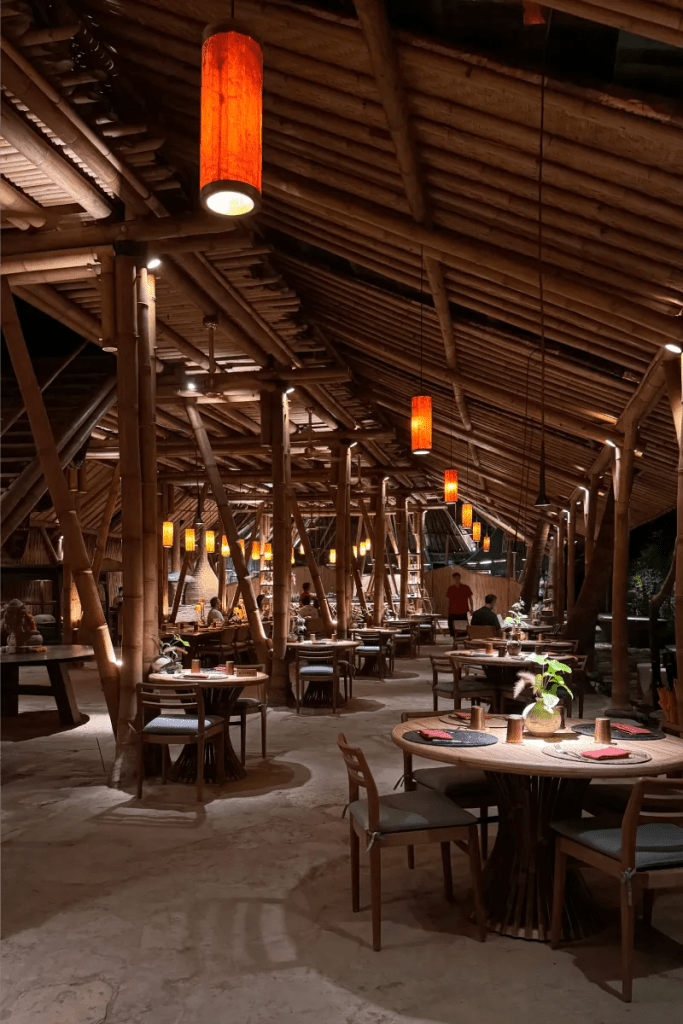
On our second day at Bambu Indah, we had lunch at Tembaga, the resort’s second in-house restaurant. This vast open-air dining room, framed by soaring bamboo beams, is located just beyond the front office and behind the ring of restored teak houses that surround the salt-chlorinated swimming pool.
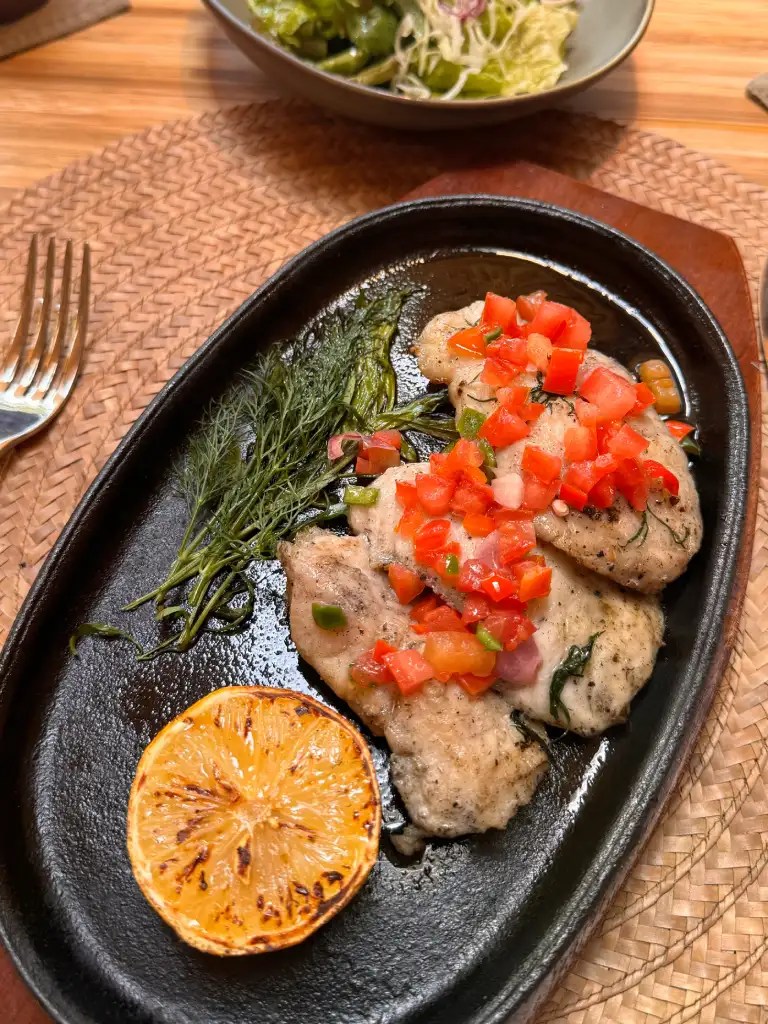
Tembaga specializes in anti-inflammatory, health-focused cuisine. I ordered the grilled fish, served with a small side salad crowned with delicate, frizzled taro strips. There were no other guests dining at the time, so we had the restaurant all to ourselves.
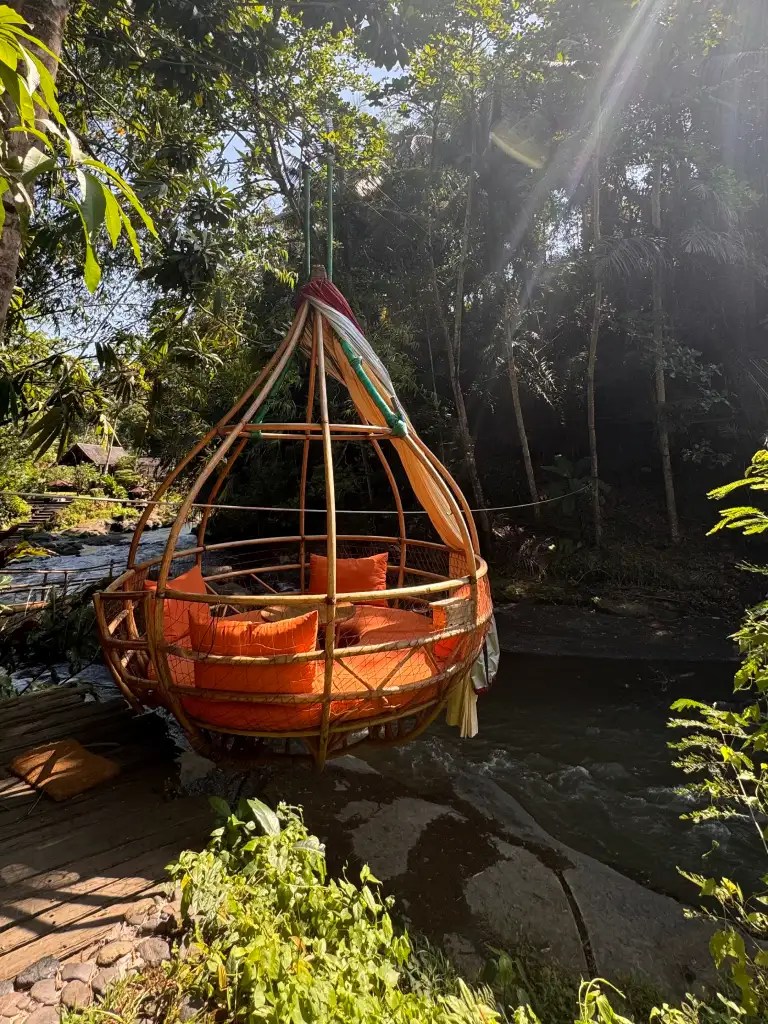
Bambu Indah has a floating bale / river pod where guests can enjoy a meal while suspended above the Ayung River. This one-of-a-kind offering (one of many unique experiences at the resort) requires an additional fee. Check with the front desk for availability and pricing.
The Pools: A Relaxing Oasis
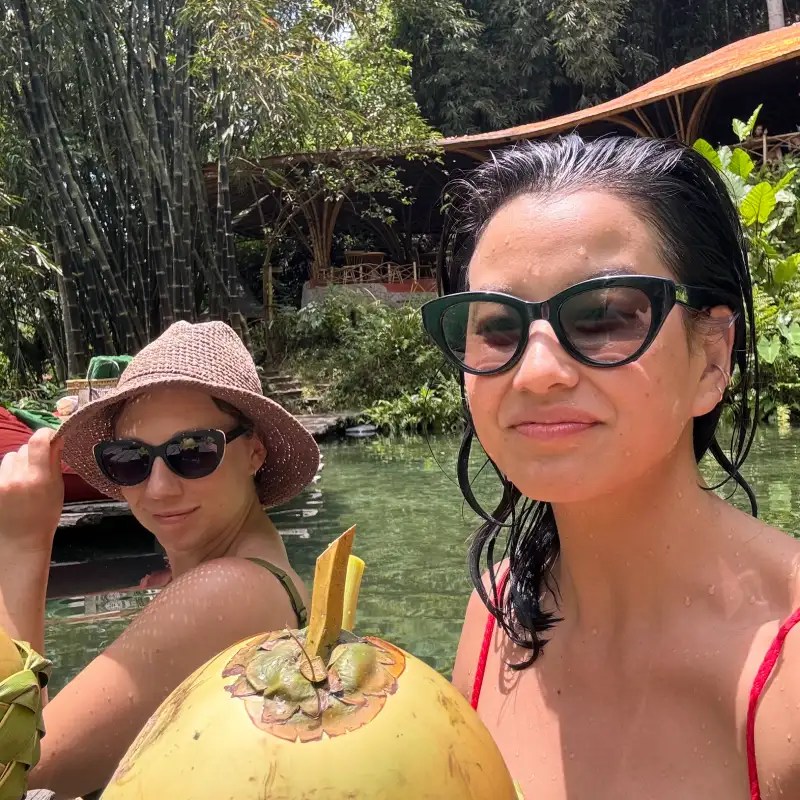
One of Bambu Indah’s most alluring features is its series of natural, spring-fed pools, seamlessly integrated into the lush jungle by the River Ayung. These pools are filtered through volcanic rock, offering a chemical-free, eco-friendly, rejuvenating swimming experience. As we floated, vibrant Indonesian red-winged dragonflies flitted above. I’d never seen a red one before!
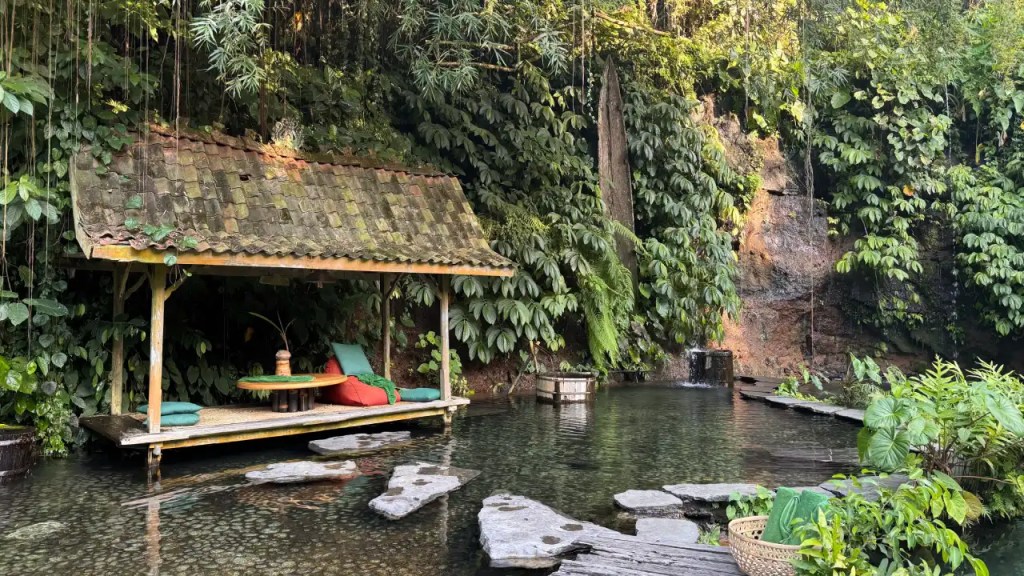
There are a variety of lounges near the pools. Choose from Thai triangle pillows, firm red bean bags, and hanging moon chairs of various sizes. A few cabanas offer shaded comfort, but they tend to fill up quickly – arrive early to claim your spot.
Most seating consists of bean bags, some tucked into more private nooks, while others line well-trodden paths between pools. The latter may not be ideal for lounging, with people constantly passing through. Our strategy? Mark your desired spot with towels before heading to breakfast.
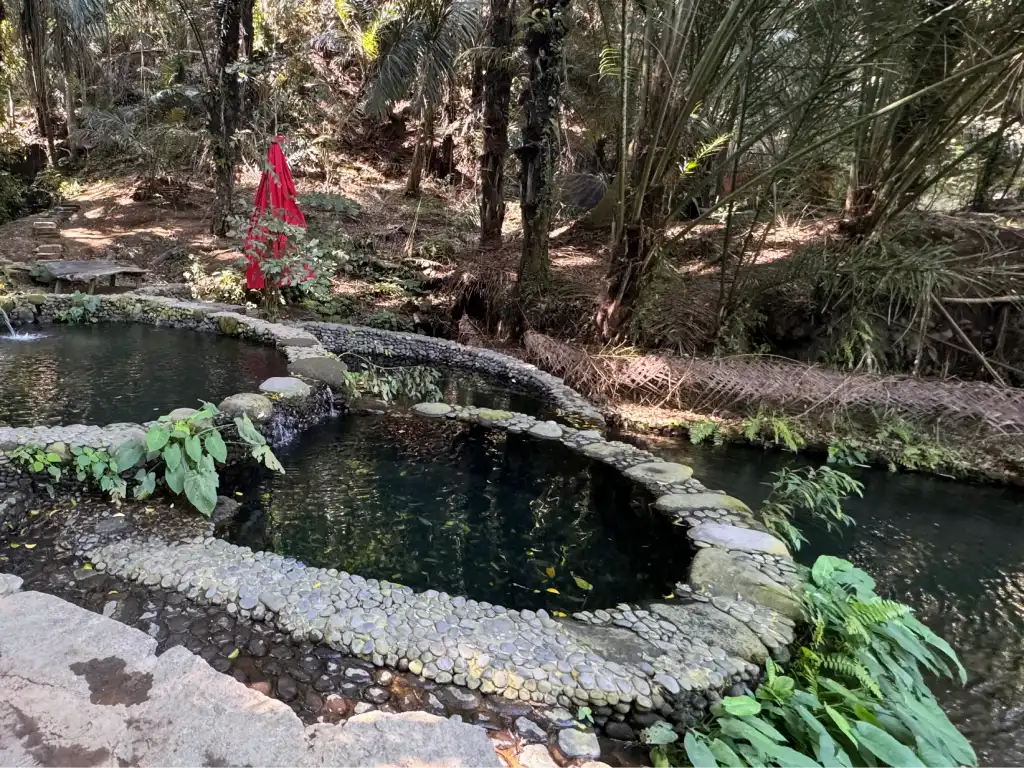
For a more secluded experience, cross the Ayung River to a “hidden” area where you’ll find a small stable, home to Bambu and Indah, the resort’s namesake calves. This side of the property features additional natural pools, surrounded by dense foliage that provides cool, shaded swimming. Unlike the main pools, there is no seating, so bring a towel if you plan to linger. It’s a retreat from Bali’s intense midday sun.
For those not staying overnight, Bambu Indah offers day passes that grant outside guests access to the pools, a fantastic way to experience this jungle paradise, even if just for the day.

The natural pools are (naturally) the highlight of the resort and grow increasingly crowded as resort guests finish their breakfasts and day pass guests trickle in. Not to worry, as there are more pools still – the salt-chlorinated pools near the teak houses and Tembaga restaurant are another lovely place to take a cool dip.
Wellness, Massage, and Yoga
Before our stay at Bambu Indah, I received an email offering a 90-minute full-body Balinese massage for the price of 60 minutes, an incredible value at roughly $35 USD/pp. While massages in town can be found for $15-20 USD, we leaned into laziness at the resort and chose to take advantage of the hotel amenities.
Our masseuses met us at the Riverside Warung and guided us to our private massage hut accessible by a pathway just beyond the natural pools. The scent of frangipani oil filled the air, and the sound of the Ayung River rushing nearby added to the sensory escape. The massage itself was excellent, evidenced by how often I drifted in and out of sleep.
Afterward, bodies like jello, we ambled back to our tent for some downtime before heading to the bar for another sunset.
Bambu Indah has also since installed a riverside sauna built from natural materials, a cold plunge, as well as two yoga shalas (three more reasons to return).
Elevator Sunset Bar: An Evening Cocktail Ritual

Having a sundowner at the Elevator Sunset Bar is a must. As a guest of Bambu Indah, you’d be crazy to miss it. (We made friends with a gentleman who had traveled almost an hour from Canggu Beach for the second consecutive night to enjoy a sunset drink.) Perched above a lush stretch of rice paddies, the space gives way to sweeping views of the incredibly lush landscape.
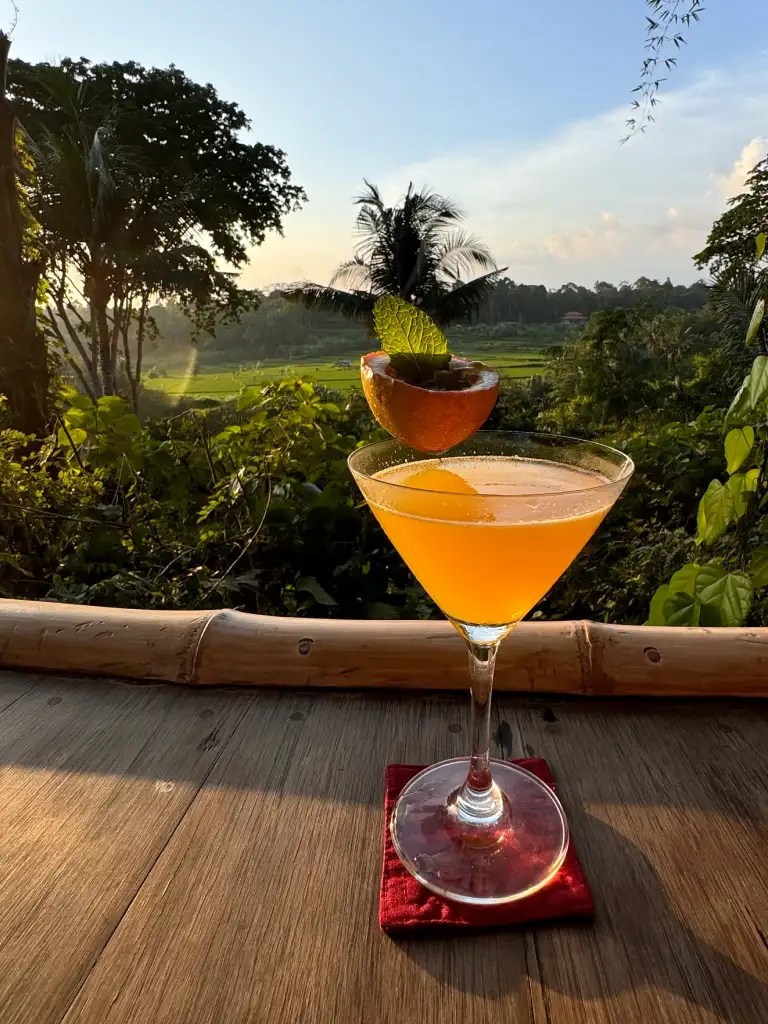
The cocktail list mixes tropical flavors with regional ingredients. On our first night, I ordered a tart, refreshing passionfruit martini and the next evening, I tried a cocktail made with arak, a traditional Balinese spirit.
If I had the opportunity to return to Ubud, I wouldn’t hesitate to stay at either of these properties again.
Komaneka at Monkey Forest was a centrally-located gem that offered incredible hospitality. The thought and care put into the design of Bambu Indah, with its organic, undulating curves and surrounding greenery made for a deeply restorative environment.
I’d be tempted to explore another one of the Komaneka hotels or upgrade my style of lodging if I were to return to Bambu Indah. However, knowing myself and my preference for novelty, I’d likely seek out yet another version of Ubud.

Leave a Reply